
Showing posts with label case study. Show all posts
Showing posts with label case study. Show all posts
Sunday, 14 October 2012

Other Windows
'Pimps Don't Cry'
The song, which appears in the motion picture The Other Guys, was so popular amongst the audience that it is now actually available to download on iTunes. Even though the song was only a short snippet in the film, Cee Lo Green and Eva Mendes teamed up and produced an official single selling at £0.79p a copy and was released on 3rd August 2010. The single has surprisingly proved popular and has therefore generated more money alongside the film, and at the same time, increased publicity of The Other Guys. Here is a clip from the film, showing Eva Mendes singing to her 'husband' Will Ferrell:
DVD/Blu-Ray/Download/Online Rental
Copies of the film are available to purchase in any form, whether it be a hard copy or a download from iTunes (There is even a HD option), or even to rent from an online distributor such as Netflix. All these windows will carry on generating money up to years after the film's ending date to be shown in the cinema, and is where a lot of film's make the most of their profits.
DVD sales for The Other Guys were impressive as 2,111,507 units were sold, resulting in $36,297,562 in consumer spends from DVD and Blu-Ray alone.
Sequel?
In the extended DVD edition, the film concludes with a second cameo appearance by Jeter, now homeless, who hands Terry and Allen a manilla folder containing details on "Their next case", seemingly setting up a sequel. Also, director Adam McKay stated in an interview with MTV that if the film does a good job at the box office and a fan base grows, then a sequel could be possible. There is every possibility that there could be an 'The Other Guys 2', opening more windows for the first edition of the film, as people who are interested in the second movie will watch the first one in order to follow the storyline.
The song, which appears in the motion picture The Other Guys, was so popular amongst the audience that it is now actually available to download on iTunes. Even though the song was only a short snippet in the film, Cee Lo Green and Eva Mendes teamed up and produced an official single selling at £0.79p a copy and was released on 3rd August 2010. The single has surprisingly proved popular and has therefore generated more money alongside the film, and at the same time, increased publicity of The Other Guys. Here is a clip from the film, showing Eva Mendes singing to her 'husband' Will Ferrell:
DVD/Blu-Ray/Download/Online Rental
Copies of the film are available to purchase in any form, whether it be a hard copy or a download from iTunes (There is even a HD option), or even to rent from an online distributor such as Netflix. All these windows will carry on generating money up to years after the film's ending date to be shown in the cinema, and is where a lot of film's make the most of their profits.
DVD sales for The Other Guys were impressive as 2,111,507 units were sold, resulting in $36,297,562 in consumer spends from DVD and Blu-Ray alone.
Sequel?
In the extended DVD edition, the film concludes with a second cameo appearance by Jeter, now homeless, who hands Terry and Allen a manilla folder containing details on "Their next case", seemingly setting up a sequel. Also, director Adam McKay stated in an interview with MTV that if the film does a good job at the box office and a fan base grows, then a sequel could be possible. There is every possibility that there could be an 'The Other Guys 2', opening more windows for the first edition of the film, as people who are interested in the second movie will watch the first one in order to follow the storyline.
The 'Players'
Director: Adam McKay
Writers: Chris Henchy & Adam McKay
Actors: Will Ferrell, Mark Wahlberg, The Rock, Eva Mendes, Samuel L. Jackson, Michael Keaton, Anne Heche, Steve Coogan, Rob Riggle, & Ray Stevenson
Producers: Patrick Crowley, Chris Henchy (Executive), & Adam McKay (Executive)
Cinematographer: Oliver Wood
Music: Jon Brion
Editor: Brent White
Studio: Gary Sanchez Productions & Mosiac Media Group
Distributors: Columbia Pictures
Narrator: Ice-T
Practical Visual Effects Work: KernerFX
Principal Photography for the film began on September 23rd 2009 in New York City, with additional scenes filmed in Albany, New York.

Writers: Chris Henchy & Adam McKay
Actors: Will Ferrell, Mark Wahlberg, The Rock, Eva Mendes, Samuel L. Jackson, Michael Keaton, Anne Heche, Steve Coogan, Rob Riggle, & Ray Stevenson
Producers: Patrick Crowley, Chris Henchy (Executive), & Adam McKay (Executive)
Cinematographer: Oliver Wood
Music: Jon Brion
Editor: Brent White
Studio: Gary Sanchez Productions & Mosiac Media Group
Distributors: Columbia Pictures
Narrator: Ice-T
Practical Visual Effects Work: KernerFX
Principal Photography for the film began on September 23rd 2009 in New York City, with additional scenes filmed in Albany, New York.

The Other Guys: On Set
With the madness of Christmas at Rockefeller Center 28 stories below them, Ferrell and his collaborators were hard at work shooting a summer comedy. The Other Guys had been taking over sections of New York for months, filming car chase and shootouts all over the city, but the day I visited the set with some online colleagues, things were limited to a regular office scene - but that didn't mean they were normal. A routine investigation of a businessman's suicide devolved into silliness when detectives played by Will Ferrell and Mark Wahlberg were assigned to the case, and that's even before their competition, played by Rob Riggle and Damon Wayans Jr., showed up to taunt them and maybe flirt with each other a little.
As you probably already learned in the movie's trailer, The Other Guys stars Ferrell and Wahlberg as a pair of detectives who finally get a chance to step up to the big leagues when the force's star cops - played by Samuel L. Jackson and Dwayne Johnson - are indisposed. No one was telling us whether or not the star cops die or simply get injured early in the film, but given the wild tone of the film, I'd count on a spectacular death sequence. Given the chance to investigate a suicide, the pair of cops jump all over their opportunity to hit the big league, but they're constantly being investigated by both their boss (Michael Keaton) and the rival team of cops played by Riggle and Wayans, who always show up to try and take them down.
We saw all of that in the scene they were filming that day in 30 Rock, where Ferrell and Wahlberg arrive to investigate the scene and start collecting clues, only for Keaton to show up and take them off the case, telling them all the reasons their clues mean nothing. Rubbing salt in the wounds are Riggle and Wayans, who have become so popular for their own work that they were at a bar doing shots with Derek Jeter, while Wahlberg's character has become notorious for, uh, shooting Derek Jeter. In the leg. The fact that Wahlberg is a famous Bostonian and Red Sox fan will probably make this movie a huge hit in Boston, as Wahlberg himself pointed out on the set.
Director Adam McKay took the cast through a lot - a lot -of takes of each scene, both to capture the standard different camera angles and to allow the actors room to improvise. They would stick to the script for a few takes to get the lines down, then McKay would encourage them to improvise, with every one of the actors getting in on the fun. Keaton constantly made up different photos to pull out of the envelope that was supposed to contain evidence - quilting patterns was one - while Riggle and Wayans, who ended the scene, carried out their final dialogue to the point that, in the last take, the two buddy partners seemed on the verge of making out. Even Wahlberg, who may be the least experienced in improv among all of them, was able to get in on it with McKay encouraging him, using some of his trademark intensity to make it truly hilarious when his character was demoted to the traffic beat.
Though we couldn't see McKay from the monitors we were watching, it was fascinating to watch the way Ferrell works with him from on camera. At one point we could hear McKay telling Ferrell he was "like the coach's son," basically telling him he was in charge among the fellow actors. I couldn't think of a better way to describe the working relationship between an actor and a director doing their fourth movie together; the two clearly get one another in a way that makes any great collaboration possible, and though Ferrell is the star, he also recognizes to help McKay turn the movie into what he wants to make it. As an unabashed fan of everything they've done together so far, I was really encouraged to see this kind of collaboration happening between them on The Other Guys as well.
You can call this overkill, but I swear this is true - we were joined as visitors on the set by a family from Kentucky who were there because the youngest son was a Make-a-Wish kid, and apparently had the dream of visiting a Hollywood set. During on break Ferrell came over to chat with the entire family, take countless photos and sign T-shirts, and chatted amiably with them about their experience in New York. While we journalists moaned about being stuck inside on a Saturday afternoon, this kid and his family were thrilled to be in the very room. Way to put us in our place.
During breaks between scenes we got a chance to talk with all the principal actors as well as McKay and screenwriter Chris Henchy. Below is the interview with Ferrell and Wahlberg, and we'll be running all the rest of the interviews throughout the day. Included in the interview are three brand-new images from the film that you'll only find at the sites that visited the set - and given how small that 30 Rock office was, there weren't that many of us. The Other Guys comes out August 6 this year, just in time for you to be totally sick of actual action movies and ready for a summer movie that is actually intentionally making you laugh.

There have been a lot of buddy cop comedies over the years. What made you and Adam decide to do one?
Will Ferrell: We just were big fans of Mark’s, and just thought that no one’s really used him in a comedy this way. If he was up for it we thought it’d be a fun kind of thing to do.
Mark Wahlberg: I’ve been dying to do a comedy, and these guys took me to dinner and bought a bunch of nice wine and said, “Do you want to do a movie?” I said, “Are you kidding me?” If you do the wrong kind of comedy you never get a chance to do it again if you come from my background. Having an opportunity to work with these guys was a real dream come true. Then they actually went through with it and wrote this part that was right up my alley, and I get to work with this guy so it’s a no-brainer for me.
Was it intimidating for you?
Wahlberg: No, because they were very clear that they would take me under their wing and protect me. I always thought comics are completely different from what they appear to be onscreen. You hear stories of how serious they are, how they try to be funny during a take but in-between takes it’s weird and awkward. These guys aren’t like that. Ferrell: We’re more weird and awkward. (laughs) We just thought it would be a great opportunity to comment on the genre. To do what we do and put the spin on the buddy cop movie.
Who’s good cop and who’s bad cop?
Wahlberg: I try to get him to play good cop/bad cop in the movie. We’re confronting this guy. I say, “I go hard, then you come in.” I tear into this guy, and next thing you know this guy goes twice as bananas as me. [Note: you can see this scene in the trailer]
Ferrell: I mishear him, I think he says “bad cop/bad cop”.
Wahlberg: He goes bananas. To see Steve Coogan’s face when Will went nuts was pretty damn funny.
Mark, what are you learning from Will about comedy improv?
Wahlberg: These guys go non-stop, and not only Will but anybody, whether it’s a bit part or a day-player, everybody that comes in is on fire. You got to be on your toes and they let me riff. Every time they do a scene you get a couple takes that are written, then you go nuts. I’m always trying to learn from every single person I work with. If I was ever the most experienced person on set that’s when I’d be nervous. When you have guys like these around you, you feel like you can do anything you want to do and still come off looking good.
This cast is huge. When you say, “Be in my movie,” does everyone come ‘a running?
Ferrell: This one was so cool because we started making these movies and said, “Wouldn’t it be fantastic to get that person?” and there was no way in hell. With this movie the people we actually wanted were like, “Of course, we’ll do it.” It’s nice to see that our work has been liked to the point where you picture Eva Mendes and she’s like, “Sure, tell me when.” Everyone was really looking forward to being a part of this.
Wahlberg: And she plays his wife! (laughs) Ferrell: Which is a natural conclusion; I don’t know why you’re all laughing. (laughs)

How is it shooting in New York?
Ferrell: We love it. It’s such an energy to shoot here. Definitely when you’re doing an exterior in a big crowded part of the city there’s some issues with people constantly yelling. “HEY ENTOURAGE! I LOVE ENTOURAGE!” (laughs) Wahlberg: Or you tell people to wait for a minute and they just walk right through the shot. Even old ladies! They’re like, “I don’t give a fuck.”
Will, I think we heard Adam on the set treating you like the coach’s son. Is that what your working relationship is right now, you’re kind of one and the same?
Ferrell: A little bit. I’m more like a coach’s son who was never good at basketball, not allowed anywhere near the court, I just got to fill the water bottles, wash the towels. We don’t even really think about what it is we do because it’s our fourth movie; we kind of know what the other guy is thinking. It’s pretty open territory. It’s not just me, though, he’s open with everybody. It’s best idea wins. He’s one of the few directors to say, “Frank the sound guy had a good idea, we’re going to do this.” He’ll give credit; he takes no ownership of anything. The biggest thing you want to set up is a feeling that if you fail it’s okay. At least 50% of the stuff we come up with, and probably 80% on some days, is terrible. But the 20% is so good it’s worth it. As long as you have that going in and everyone feels comfortable and it’s a great working environment. Adam sets that up.
How realistic is this? Your movies have gotten pretty wacky in the past.
Ferrell: This might be the most realistic thing we’ve done. We are real detectives, and we want this stark, real, gritty background so when we throw in these jokes they bounce even higher.
Wahlberg: Every time we’re doing something we’re trying to make each other laugh and say something funny, Adam’s always like, “Make sure you say something about the case…”
Ferrell: There aren’t any broad portrayals, or super-over-the-top characters.
Wahlberg: Certainly with me I’m trying to stay as committed as possible no matter how absurd it is, and hopefully that’ll translate as funny as opposed to doing pratfalls and shit.
Mark, can you talk about shooting Derek Jeter? Is that something you wrote into the script?
Wahlberg: That was something they were nice enough to write in for me, and he was dumb enough to do it. No, I took great pleasure in that, especially after them winning the World Series.
Ferrell: (laughs) We had to openly root for the Yankees this year.
Wahlberg: We wanted them to show up in a good mood. The Red Sox were already out of it anyway, so I was okay with that. I got to have my cake and eat it too. We were sitting there talking and laughing and I told him, “Do you know how this movie’s going to play like in Boston when I shoot you in the leg?” Just that is enough to cement me in Boston for the rest of my life.

Credit to cinemablend.com
As you probably already learned in the movie's trailer, The Other Guys stars Ferrell and Wahlberg as a pair of detectives who finally get a chance to step up to the big leagues when the force's star cops - played by Samuel L. Jackson and Dwayne Johnson - are indisposed. No one was telling us whether or not the star cops die or simply get injured early in the film, but given the wild tone of the film, I'd count on a spectacular death sequence. Given the chance to investigate a suicide, the pair of cops jump all over their opportunity to hit the big league, but they're constantly being investigated by both their boss (Michael Keaton) and the rival team of cops played by Riggle and Wayans, who always show up to try and take them down.
We saw all of that in the scene they were filming that day in 30 Rock, where Ferrell and Wahlberg arrive to investigate the scene and start collecting clues, only for Keaton to show up and take them off the case, telling them all the reasons their clues mean nothing. Rubbing salt in the wounds are Riggle and Wayans, who have become so popular for their own work that they were at a bar doing shots with Derek Jeter, while Wahlberg's character has become notorious for, uh, shooting Derek Jeter. In the leg. The fact that Wahlberg is a famous Bostonian and Red Sox fan will probably make this movie a huge hit in Boston, as Wahlberg himself pointed out on the set.
Director Adam McKay took the cast through a lot - a lot -of takes of each scene, both to capture the standard different camera angles and to allow the actors room to improvise. They would stick to the script for a few takes to get the lines down, then McKay would encourage them to improvise, with every one of the actors getting in on the fun. Keaton constantly made up different photos to pull out of the envelope that was supposed to contain evidence - quilting patterns was one - while Riggle and Wayans, who ended the scene, carried out their final dialogue to the point that, in the last take, the two buddy partners seemed on the verge of making out. Even Wahlberg, who may be the least experienced in improv among all of them, was able to get in on it with McKay encouraging him, using some of his trademark intensity to make it truly hilarious when his character was demoted to the traffic beat.
Though we couldn't see McKay from the monitors we were watching, it was fascinating to watch the way Ferrell works with him from on camera. At one point we could hear McKay telling Ferrell he was "like the coach's son," basically telling him he was in charge among the fellow actors. I couldn't think of a better way to describe the working relationship between an actor and a director doing their fourth movie together; the two clearly get one another in a way that makes any great collaboration possible, and though Ferrell is the star, he also recognizes to help McKay turn the movie into what he wants to make it. As an unabashed fan of everything they've done together so far, I was really encouraged to see this kind of collaboration happening between them on The Other Guys as well.
You can call this overkill, but I swear this is true - we were joined as visitors on the set by a family from Kentucky who were there because the youngest son was a Make-a-Wish kid, and apparently had the dream of visiting a Hollywood set. During on break Ferrell came over to chat with the entire family, take countless photos and sign T-shirts, and chatted amiably with them about their experience in New York. While we journalists moaned about being stuck inside on a Saturday afternoon, this kid and his family were thrilled to be in the very room. Way to put us in our place.
During breaks between scenes we got a chance to talk with all the principal actors as well as McKay and screenwriter Chris Henchy. Below is the interview with Ferrell and Wahlberg, and we'll be running all the rest of the interviews throughout the day. Included in the interview are three brand-new images from the film that you'll only find at the sites that visited the set - and given how small that 30 Rock office was, there weren't that many of us. The Other Guys comes out August 6 this year, just in time for you to be totally sick of actual action movies and ready for a summer movie that is actually intentionally making you laugh.
There have been a lot of buddy cop comedies over the years. What made you and Adam decide to do one?
Will Ferrell: We just were big fans of Mark’s, and just thought that no one’s really used him in a comedy this way. If he was up for it we thought it’d be a fun kind of thing to do.
Mark Wahlberg: I’ve been dying to do a comedy, and these guys took me to dinner and bought a bunch of nice wine and said, “Do you want to do a movie?” I said, “Are you kidding me?” If you do the wrong kind of comedy you never get a chance to do it again if you come from my background. Having an opportunity to work with these guys was a real dream come true. Then they actually went through with it and wrote this part that was right up my alley, and I get to work with this guy so it’s a no-brainer for me.
Was it intimidating for you?
Wahlberg: No, because they were very clear that they would take me under their wing and protect me. I always thought comics are completely different from what they appear to be onscreen. You hear stories of how serious they are, how they try to be funny during a take but in-between takes it’s weird and awkward. These guys aren’t like that. Ferrell: We’re more weird and awkward. (laughs) We just thought it would be a great opportunity to comment on the genre. To do what we do and put the spin on the buddy cop movie.
Who’s good cop and who’s bad cop?
Wahlberg: I try to get him to play good cop/bad cop in the movie. We’re confronting this guy. I say, “I go hard, then you come in.” I tear into this guy, and next thing you know this guy goes twice as bananas as me. [Note: you can see this scene in the trailer]
Ferrell: I mishear him, I think he says “bad cop/bad cop”.
Wahlberg: He goes bananas. To see Steve Coogan’s face when Will went nuts was pretty damn funny.
Mark, what are you learning from Will about comedy improv?
Wahlberg: These guys go non-stop, and not only Will but anybody, whether it’s a bit part or a day-player, everybody that comes in is on fire. You got to be on your toes and they let me riff. Every time they do a scene you get a couple takes that are written, then you go nuts. I’m always trying to learn from every single person I work with. If I was ever the most experienced person on set that’s when I’d be nervous. When you have guys like these around you, you feel like you can do anything you want to do and still come off looking good.
This cast is huge. When you say, “Be in my movie,” does everyone come ‘a running?
Ferrell: This one was so cool because we started making these movies and said, “Wouldn’t it be fantastic to get that person?” and there was no way in hell. With this movie the people we actually wanted were like, “Of course, we’ll do it.” It’s nice to see that our work has been liked to the point where you picture Eva Mendes and she’s like, “Sure, tell me when.” Everyone was really looking forward to being a part of this.
Wahlberg: And she plays his wife! (laughs) Ferrell: Which is a natural conclusion; I don’t know why you’re all laughing. (laughs)
How is it shooting in New York?
Ferrell: We love it. It’s such an energy to shoot here. Definitely when you’re doing an exterior in a big crowded part of the city there’s some issues with people constantly yelling. “HEY ENTOURAGE! I LOVE ENTOURAGE!” (laughs) Wahlberg: Or you tell people to wait for a minute and they just walk right through the shot. Even old ladies! They’re like, “I don’t give a fuck.”
Will, I think we heard Adam on the set treating you like the coach’s son. Is that what your working relationship is right now, you’re kind of one and the same?
Ferrell: A little bit. I’m more like a coach’s son who was never good at basketball, not allowed anywhere near the court, I just got to fill the water bottles, wash the towels. We don’t even really think about what it is we do because it’s our fourth movie; we kind of know what the other guy is thinking. It’s pretty open territory. It’s not just me, though, he’s open with everybody. It’s best idea wins. He’s one of the few directors to say, “Frank the sound guy had a good idea, we’re going to do this.” He’ll give credit; he takes no ownership of anything. The biggest thing you want to set up is a feeling that if you fail it’s okay. At least 50% of the stuff we come up with, and probably 80% on some days, is terrible. But the 20% is so good it’s worth it. As long as you have that going in and everyone feels comfortable and it’s a great working environment. Adam sets that up.
How realistic is this? Your movies have gotten pretty wacky in the past.
Ferrell: This might be the most realistic thing we’ve done. We are real detectives, and we want this stark, real, gritty background so when we throw in these jokes they bounce even higher.
Wahlberg: Every time we’re doing something we’re trying to make each other laugh and say something funny, Adam’s always like, “Make sure you say something about the case…”
Ferrell: There aren’t any broad portrayals, or super-over-the-top characters.
Wahlberg: Certainly with me I’m trying to stay as committed as possible no matter how absurd it is, and hopefully that’ll translate as funny as opposed to doing pratfalls and shit.
Mark, can you talk about shooting Derek Jeter? Is that something you wrote into the script?
Wahlberg: That was something they were nice enough to write in for me, and he was dumb enough to do it. No, I took great pleasure in that, especially after them winning the World Series.
Ferrell: (laughs) We had to openly root for the Yankees this year.
Wahlberg: We wanted them to show up in a good mood. The Red Sox were already out of it anyway, so I was okay with that. I got to have my cake and eat it too. We were sitting there talking and laughing and I told him, “Do you know how this movie’s going to play like in Boston when I shoot you in the leg?” Just that is enough to cement me in Boston for the rest of my life.
The Other Guys: Box Office Figures
Domestic Total Gross: $119,219,978
Distributor: Sony/Columbia
Genre: Action Comedy
MPAA Rating: PG-13
Release Date: August 6th 2010
Runtime: 1hrs. 47 min.
Production Budget: $100 million
Domestic: $119,219,978 = 70%
+ Foreign: $51,212,949 = 30%
-------------------------------------------
= Worldwide: $170,432,927
Domestic Summary
Opening Weekend: $35,543,162
(#1 rank, 3,651 theatres, $9,735 average)
% of Total Gross: 29.8%
Widest Release: 3,651 theatres
Close Date: November 18th 2010
In Release: 105 days/15 weeks
Distributor: Sony/Columbia
Genre: Action Comedy
MPAA Rating: PG-13
Release Date: August 6th 2010
Runtime: 1hrs. 47 min.
Production Budget: $100 million
Domestic: $119,219,978 = 70%
+ Foreign: $51,212,949 = 30%
-------------------------------------------
= Worldwide: $170,432,927
Domestic Summary
Opening Weekend: $35,543,162
(#1 rank, 3,651 theatres, $9,735 average)
% of Total Gross: 29.8%
Widest Release: 3,651 theatres
Close Date: November 18th 2010
In Release: 105 days/15 weeks
Promotion/Marketing for The Other Guys
In July 2010, both Wahlberg and Ferrell appeared at the San Diego Comic-Con International to promote their film.
 Credit to the Los Angeles Times.

During an episode of Big Brother, the house guests competed in a luxury challenge to see an advance screening of the film. Although they weren't actually in the house, both Will Ferrell and Mark Wahlberg made an on-screen video appearance.
During the August 4th, 2010 episode of America's Got Talent, the week's contestants saw an advance screening of the film and got to meet both Will Ferrell and Mark Wahlberg.
Ferrell and Wahlberg also made a cameo appearance on an episode of WWE Raw to promote the film.
During the week leading up to the release date, the film was promoted on TruTV programmes, specifically The Smoking Gun Presents: World's Dumbest... During the segments were shown during the commercial breaks of the show's cast broken down on a highway, discussing several movies, as part of a promotional tie-in; with The Other Guys being one of them.
They appeared in on screen advertising on broadcast sports events such as MLB and NASCAR.
Premiere
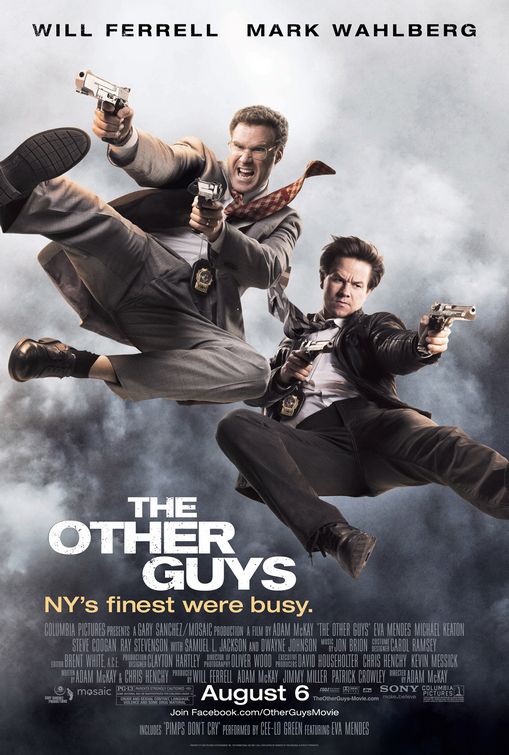
Mark Wahlberg and Will Ferrell, hot off Wahlberg's ceremony awarding him a star on Hollywood's Walk of Fame, turned up at New York's Ziegfeld Theatre on Monday 30th July for the premiere of "The Other Guys," joining costars Eva Mendes, Samuel L. Jackson and others on a "red carpet" styled to look like police tape.
Mark Wahlberg and Will Ferrell, hot off Wahlberg's ceremony awarding him a star on Hollywood's Walk of Fame, turned up at New York's Ziegfeld Theatre on Monday 30th July for the premiere of "The Other Guys," joining costars Eva Mendes, Samuel L. Jackson and others on a "red carpet" styled to look like police tape.
The after party was held at the Park restaurant in Manhattan.
Other cast members on hand included Steve Coogan, Rob Riggle, Horatio Sanz, Lindsay Sloane, Tess Kartel, Ray Stevenson and Brooke Shields, who appears in the movie as herself. Writer Chris Hency made the scene, as did director Adam McKay. Jackson brought wife LaTanya Richardson, and Ferrell had wife Viveca Paulin as his date.
Other cast members on hand included Steve Coogan, Rob Riggle, Horatio Sanz, Lindsay Sloane, Tess Kartel, Ray Stevenson and Brooke Shields, who appears in the movie as herself. Writer Chris Hency made the scene, as did director Adam McKay. Jackson brought wife LaTanya Richardson, and Ferrell had wife Viveca Paulin as his date.
Ice-T and Coco made it safely into town for the event, joining the likes of Star Jones, Jimmy Fallon, Damon Wayans Jr. and Matchbox Twenty frontman Rob Thomas.
The premiere of the new Hollywood film The Other Guys has been promoted using replica NYPD cars featuring vehicle graphics produced by Signs Express Bristol.
The south-west franchise, which provides a range of vehicle marking services as well as general signage, was commissioned to create two full vehicle wraps for the film.
"The cars were yellow taxis when we received them so we set about wrapping the entire body in white and then applying the replica police graphics," explains Jon Miller-Wilson, franchisee for Signs Express Bristol. "It's created a fantastic stage backdrop for the film premiere."


Saturday, 13 October 2012
The Other Guys: End Credits
"You don’t normally expect a Will Ferrell comedy to be educational, but if you caught The Other Guys this weekend and stuck around for the closing credits, then maybe you learned something. The movie’s crime plot is wrapped around the notion of rich people ripping off the little guy and so when the closing credits rolled, instead of simply throwing the names of the cast and crew at you The Other Guys stops down to explain the real-world economic collapse, in a way people can actually understand, using simple animation.
Speaking as someone who spends all of his time watching movies and therefore knows nothing about the intricacies of finance, simply understanding what’s happened has been well beyond my grasp. I think that’s true for a lot of you. All I know is I’m poorer than I was two years ago, and most everyone I know is out of work. Why? It’s so complex it has defied explanation to the common man. What’s brilliant about the Other Guysclosing credits animation sequence is that it manages to distill the country’s financial problems down to their most basic form, and delivers them in a creative and entertaining way that, unlike anything you’re likely to see on the news, almost anyone can understand.
The animation sequence was designed by Picture Mill, whom we hope to talk to about their work early next week. In the meantime they’ve made the entire, closing credits to The Other Guys available online. Get educated, watch it embedded below and then click over to Picture Mill where they’ve also made available the movie’s rather creative (but less educational) opening credits."
Credit to cinemablend.com
Speaking as someone who spends all of his time watching movies and therefore knows nothing about the intricacies of finance, simply understanding what’s happened has been well beyond my grasp. I think that’s true for a lot of you. All I know is I’m poorer than I was two years ago, and most everyone I know is out of work. Why? It’s so complex it has defied explanation to the common man. What’s brilliant about the Other Guysclosing credits animation sequence is that it manages to distill the country’s financial problems down to their most basic form, and delivers them in a creative and entertaining way that, unlike anything you’re likely to see on the news, almost anyone can understand.
The animation sequence was designed by Picture Mill, whom we hope to talk to about their work early next week. In the meantime they’ve made the entire, closing credits to The Other Guys available online. Get educated, watch it embedded below and then click over to Picture Mill where they’ve also made available the movie’s rather creative (but less educational) opening credits."
Credit to cinemablend.com
Friday, 12 October 2012
Adam McKay Interview: The Other Guys
How did the film come about? Did the genre spoof concept come first, and was Will Ferrell definitely involved?

I suppose it was like you’d stumbled into a Michael Moore documentary, where you’re suddenly hit by all these raw facts, figures, and references. Do you think that the audience that will go and see a Will Ferrell buddy cop comedy will care about that information?
I think I might have forgotten the world at large a little on that, because, from my perspective, when I saw them, I found them really entertaining. I thought, "Oh, these look cool! They look kinda beautiful!"
And there’s a magazine in the US, Harper’s, and they have Harper’s Index, which are the numbers, the stats. I’ve always found that to be entertaining, even though they’re jaw-dropping and startling.
So, when I saw it, and we played the Pimps Don’t Cry song over it, and the Rage Against the Machine, I thought, "Wow, these are really cool!" And then when we started getting the reaction of, "Oh my god, it becomes a Michael Moore film in the credits," I was really surprised.
I also thought of the financial thing as not really political. We all agree that it happened. But I underestimated the old corporate media in the United States and the right-wing media. So, yeah, we got some complaints on that, but, ultimately, I don’t care. I think they’re cool.
They are. They’re very stylish, informative infographics. Was there any point where you thought it wouldn’t fly with the studio bosses?
Well, you know, we’re very lucky. This is going to sound like a bit of studio ass-kissing, but it’s absolutely true. Sony is the coolest studio. They are really amazing. I think part of it comes from they’re not an American corporation. They don’t work by quite the same rules. And their studio heads have a lot of autonomy.
And Amy Pascal and Matt Tolmach and Michael Lynton are really friendly to the creatives. They’re legendary for being pretty cool about stuff like that.
I also think that they know me. They knew what my intentions were, which was to do a poppy, cool sort of thing at the end. They were fine with it. They were great, and the movie did well in the end. That always helps.
And it does help that the core of the film isn’t necessarily that aspect. It’s more about the other guys, the triumph of the flawed, normal people on the periphery.
That’s really what it’s about. And part of that is creating new heroes to address these new crimes. That’s what the goal of the movie was. We always pick a highly ambitious goal for the movie, and even if you don’t achieve it, it’s a comedy, and it’s funny. So, that was sort of the goal of it.
I gotta say, I probably miscalculated a little bit on it. I did not think it was as Michael Moore-ish as it was perceived. A lot of people loved them, but I was a little surprised by that. I, from my own little cocoon world, thought they were just cool and fun.
I can imagine some of the Michael Moore comparisons come from how it is expressing polemical opinions and statistics in a poppy way. And in the landscape of cinema, only Michael Moore does that, especially in a mainstream, studio-backed way.
Well, that may be the best point, which is you don’t just see that very often. And by that virtue, right away, it lends itself to Michael Moore. Also, you don’t really ever see people call out big money in any sort of commercial entertainment way.
And in a naive way, I thought this was a very populist thing. But, you’re right, Michael Moore’s the only guy who does that. If anything, you know what, it’s a compliment to Michael Moore, the whole discussion! [laughs]
And, I suppose, the use of Rage Against the Machine... Michael Moore shot two of their music videos back in the 90s, and has collaborated with them on his soundtracks as well.
Oh, my god, the Michael Moore similarities are lining up even more!
I have been listening to that Maggie’s Farm cover for, like, four years. It’s one of my favourite covers anywhere. And I thought, "Oh my god. I can finally use it!"
I was originally going to try and do a cover of Pink Floyd’s Money, and get a cool band to do that, and then it was so pricey I couldn’t do it. So, I thought, "All right. it’s time for a little Maggie’s Farm.
Credit to 'Den of Geek' for this interview.
There’s always just some little small purchase point you have. In the case of Anchorman, it was Will saw an interview with a 70s anchorman, talking about how sexist they were. And it was that tone of voice he loved. With Talladega Nights, it was the NASCAR, Bush, Red States of America. With this one, it was really a dinner with Mark Wahlberg.
We went out with him, and Will and Mark sat next to each other, and Mark made us laugh all night long. He’s a great guy, really funny. And I just walked away, going ‘you guys have to make a movie, that is one of the most interesting, odd chemistries I’ve ever seen, and clearly he knows how to play.’
That was the genesis of it, and just from looking at them, and based on Mark’s background, I thought, well, it should probably be an action comedy. We haven’t done that yet, either, and that’s always exciting.
And then I had that idea of the other guys - who are the guys in the desks next to the superstars. And quite honestly, it wasn’t about until halfway through the whole thing that I realised that we were making a cop buddy film. It hadn’t even occurred to us, because, let’s face it, it’s almost a kind of almost a dead genre, in a way.
Really, the only good cop buddy movie in the last 10 years is Hot Fuzz, I would say. I can’t think of any others. So all of a sudden, we were like, "Oh, my god. We’re making a copy buddy film," and we actually tried as hard as we could not to have it be a spoof. But, just by virtue of it being a cop buddy film, it is a spoof. It’s like doing a comedy that’s a Western.
Immediately, it’s a spoof, even though you’re doing everything different, or trying to change things. You know you have to hit certain beats, and it’s just the way it goes. So we kind of knew that. We said,"All right. It’s going to be a cop buddy film. Let’s do our darnedest to make it as original and funny as we can. Probably we’ll fail in some cases, and then it’ll be a spoof." That’s how we got into it.

It seems that comedy directors sometimes like the idea of doing action comedy films, because it gives them a chance to indulge in a different kind of direction. That seems to be the case with the likes of Hot Fuzz and Tropic Thunder. Was that a draw for you as well?
Absolutely, yeah! With each movie we do, I want there to be something different that I get to try. Or a different location, or a different style. So I was excited about a couple things with this.
I was excited to see Will play pretty real, because I know he’s so funny when he’s doing the straight man, and so funny just being himself. So I loved that.
Clearly, I loved the chance to work with Mark Wahlberg. I hadn’t worked with him before. And then, yes, the action was really exciting for me. And to get my feet a little wet with that was a blast.
There are some amazing sequences, like the opening car chase, which turns into a bus chase. It seems like you were indulging in a bit of geekery there. Were you bringing in any nods to or influences from other films in the genre that you love?
Absolutely, yeah. And that’s a good way of putting it. It was just pure fun film geekery for me, to get to shoot that kind of stuff.
You obviously shoot some of that stuff with a second unit, they did some of that car chase stuff, and we storyboarded it. But some of the stuff I got to shoot with my crew. One of the funnest was the slow motion shootout in the conference room. That was pure John Woo, and I loved doing that with a little stolen camera movement from Zack Snyder, the push-in camera that we used.
And there was a fight on a rooftop with the motorcycle guys, and that was pure The Bourne Identity. The way we shot it - fast, and with the cuts. That’s just a blast, to get to do that stuff.
And just, as a film fan, I try to make it so it doesn’t suck. Even though it’s a comedy, you want that stuff to play well. And same with the racing in Talladega Nights, we did the best we could, as far as shooting them.
I find it interesting that, speaking generically, you say that doing a buddy cop movie now, you’re almost inherently making a spoof. If you think of the current slate of genre movies, it seems hard to do a non-ironic, non-tongue-in-cheek action film.
Films like Machete, MacGruber, Black Dynamite... and The Expendables, even though it’s a straight-faced action flick, people are approaching it like it’s in some way an OTT spoof of that type of movie...
I think you’re absolutely right. I think it’s very hard to sincerely do those kind of movies. Really, the only way to sincerely do them is to elevate the technical aspect of it so much. I mean, if you look at Avatar, could you imagine if you did Avatar for 50 million dollars? It would be ridiculous! You would almost be getting laughs from the audience, unless you got a real indie director to do something incredibly stylised.
So, yeah, if you don’t have the big, cranking, 250 million dollar budget, you definitely are going to have a spoof element to it. In our case, it was okay, because part of the satire of it was the overblown cop stars, and the overblown shootouts that really don’t do anything when banks are stealing a trillion dollars from our back pockets.
So, I was happy that we wandered into it with that, a little bit. But I think you’re right. I think it’s hard to do that kind of action straight-up.
That white-collar crime aspect is something that gives the film a contemporary, relevant edge. Was that an important element for you, from the scripting stage onwards?
I didn’t think - in fact, I think we had a little argument early on - I didn’t think you could do the movie if it was about kidnapping or diamond smuggling. I thought then you’d be full-out spoof. I felt the only crime that has any stakes or jeopardy to it now is white-collar crime. That’s where all the damage is being done. So that was my hope, that, okay, the buddy cop genre’s dead, but maybe with this new crime...
And the challenge of the movie was: can we make white-collar crime exciting? I don’t think we fully succeeded. There’s a couple parts where it plays a little dry, and I was like, "Aw, I wish I’d done it a little better." And the fact that it’s a computer transfer at the end...! But the truth is that, that is kind of what white-collar crime is!
White-collar crime has been marketed - billions of dollars have been put in to have us be bored by it. They don’t want us to be interested in that. They don’t want us to know the economic terms. They don’t want us to know - in America, especially - what the Federal Reserve is.
So, I was excited by that. I thought, "Well, this is a very poppy movie. It’s a comedy, it’s juicy and chunky, it’s the summer. If we can really make a sort of easy, breezy, financial white-collar plot that doesn’t get in the way too much, this could actually be a good chance to expose some of it." And I think we did an okay job. I wouldn’t say it was a smashing success, that part of it.
Fortunately, that’s only twenty percent of the movie. That’s sort of why I did the credits at the end, where I just said, "Screw it. I’m just gonna say it nakedly!" [laughs] And I thought the graphics were cool, and fun, so I thought it was entertaining enough to do that.
We went out with him, and Will and Mark sat next to each other, and Mark made us laugh all night long. He’s a great guy, really funny. And I just walked away, going ‘you guys have to make a movie, that is one of the most interesting, odd chemistries I’ve ever seen, and clearly he knows how to play.’
That was the genesis of it, and just from looking at them, and based on Mark’s background, I thought, well, it should probably be an action comedy. We haven’t done that yet, either, and that’s always exciting.
And then I had that idea of the other guys - who are the guys in the desks next to the superstars. And quite honestly, it wasn’t about until halfway through the whole thing that I realised that we were making a cop buddy film. It hadn’t even occurred to us, because, let’s face it, it’s almost a kind of almost a dead genre, in a way.
Really, the only good cop buddy movie in the last 10 years is Hot Fuzz, I would say. I can’t think of any others. So all of a sudden, we were like, "Oh, my god. We’re making a copy buddy film," and we actually tried as hard as we could not to have it be a spoof. But, just by virtue of it being a cop buddy film, it is a spoof. It’s like doing a comedy that’s a Western.
Immediately, it’s a spoof, even though you’re doing everything different, or trying to change things. You know you have to hit certain beats, and it’s just the way it goes. So we kind of knew that. We said,"All right. It’s going to be a cop buddy film. Let’s do our darnedest to make it as original and funny as we can. Probably we’ll fail in some cases, and then it’ll be a spoof." That’s how we got into it.

It seems that comedy directors sometimes like the idea of doing action comedy films, because it gives them a chance to indulge in a different kind of direction. That seems to be the case with the likes of Hot Fuzz and Tropic Thunder. Was that a draw for you as well?
Absolutely, yeah! With each movie we do, I want there to be something different that I get to try. Or a different location, or a different style. So I was excited about a couple things with this.
I was excited to see Will play pretty real, because I know he’s so funny when he’s doing the straight man, and so funny just being himself. So I loved that.
Clearly, I loved the chance to work with Mark Wahlberg. I hadn’t worked with him before. And then, yes, the action was really exciting for me. And to get my feet a little wet with that was a blast.
There are some amazing sequences, like the opening car chase, which turns into a bus chase. It seems like you were indulging in a bit of geekery there. Were you bringing in any nods to or influences from other films in the genre that you love?
Absolutely, yeah. And that’s a good way of putting it. It was just pure fun film geekery for me, to get to shoot that kind of stuff.
You obviously shoot some of that stuff with a second unit, they did some of that car chase stuff, and we storyboarded it. But some of the stuff I got to shoot with my crew. One of the funnest was the slow motion shootout in the conference room. That was pure John Woo, and I loved doing that with a little stolen camera movement from Zack Snyder, the push-in camera that we used.
And there was a fight on a rooftop with the motorcycle guys, and that was pure The Bourne Identity. The way we shot it - fast, and with the cuts. That’s just a blast, to get to do that stuff.
And just, as a film fan, I try to make it so it doesn’t suck. Even though it’s a comedy, you want that stuff to play well. And same with the racing in Talladega Nights, we did the best we could, as far as shooting them.
I find it interesting that, speaking generically, you say that doing a buddy cop movie now, you’re almost inherently making a spoof. If you think of the current slate of genre movies, it seems hard to do a non-ironic, non-tongue-in-cheek action film.
Films like Machete, MacGruber, Black Dynamite... and The Expendables, even though it’s a straight-faced action flick, people are approaching it like it’s in some way an OTT spoof of that type of movie...
I think you’re absolutely right. I think it’s very hard to sincerely do those kind of movies. Really, the only way to sincerely do them is to elevate the technical aspect of it so much. I mean, if you look at Avatar, could you imagine if you did Avatar for 50 million dollars? It would be ridiculous! You would almost be getting laughs from the audience, unless you got a real indie director to do something incredibly stylised.
So, yeah, if you don’t have the big, cranking, 250 million dollar budget, you definitely are going to have a spoof element to it. In our case, it was okay, because part of the satire of it was the overblown cop stars, and the overblown shootouts that really don’t do anything when banks are stealing a trillion dollars from our back pockets.
So, I was happy that we wandered into it with that, a little bit. But I think you’re right. I think it’s hard to do that kind of action straight-up.
That white-collar crime aspect is something that gives the film a contemporary, relevant edge. Was that an important element for you, from the scripting stage onwards?
I didn’t think - in fact, I think we had a little argument early on - I didn’t think you could do the movie if it was about kidnapping or diamond smuggling. I thought then you’d be full-out spoof. I felt the only crime that has any stakes or jeopardy to it now is white-collar crime. That’s where all the damage is being done. So that was my hope, that, okay, the buddy cop genre’s dead, but maybe with this new crime...
And the challenge of the movie was: can we make white-collar crime exciting? I don’t think we fully succeeded. There’s a couple parts where it plays a little dry, and I was like, "Aw, I wish I’d done it a little better." And the fact that it’s a computer transfer at the end...! But the truth is that, that is kind of what white-collar crime is!
White-collar crime has been marketed - billions of dollars have been put in to have us be bored by it. They don’t want us to be interested in that. They don’t want us to know the economic terms. They don’t want us to know - in America, especially - what the Federal Reserve is.
So, I was excited by that. I thought, "Well, this is a very poppy movie. It’s a comedy, it’s juicy and chunky, it’s the summer. If we can really make a sort of easy, breezy, financial white-collar plot that doesn’t get in the way too much, this could actually be a good chance to expose some of it." And I think we did an okay job. I wouldn’t say it was a smashing success, that part of it.
Fortunately, that’s only twenty percent of the movie. That’s sort of why I did the credits at the end, where I just said, "Screw it. I’m just gonna say it nakedly!" [laughs] And I thought the graphics were cool, and fun, so I thought it was entertaining enough to do that.

I suppose it was like you’d stumbled into a Michael Moore documentary, where you’re suddenly hit by all these raw facts, figures, and references. Do you think that the audience that will go and see a Will Ferrell buddy cop comedy will care about that information?
I think I might have forgotten the world at large a little on that, because, from my perspective, when I saw them, I found them really entertaining. I thought, "Oh, these look cool! They look kinda beautiful!"
And there’s a magazine in the US, Harper’s, and they have Harper’s Index, which are the numbers, the stats. I’ve always found that to be entertaining, even though they’re jaw-dropping and startling.
So, when I saw it, and we played the Pimps Don’t Cry song over it, and the Rage Against the Machine, I thought, "Wow, these are really cool!" And then when we started getting the reaction of, "Oh my god, it becomes a Michael Moore film in the credits," I was really surprised.
I also thought of the financial thing as not really political. We all agree that it happened. But I underestimated the old corporate media in the United States and the right-wing media. So, yeah, we got some complaints on that, but, ultimately, I don’t care. I think they’re cool.
They are. They’re very stylish, informative infographics. Was there any point where you thought it wouldn’t fly with the studio bosses?
Well, you know, we’re very lucky. This is going to sound like a bit of studio ass-kissing, but it’s absolutely true. Sony is the coolest studio. They are really amazing. I think part of it comes from they’re not an American corporation. They don’t work by quite the same rules. And their studio heads have a lot of autonomy.
And Amy Pascal and Matt Tolmach and Michael Lynton are really friendly to the creatives. They’re legendary for being pretty cool about stuff like that.
I also think that they know me. They knew what my intentions were, which was to do a poppy, cool sort of thing at the end. They were fine with it. They were great, and the movie did well in the end. That always helps.
And it does help that the core of the film isn’t necessarily that aspect. It’s more about the other guys, the triumph of the flawed, normal people on the periphery.
That’s really what it’s about. And part of that is creating new heroes to address these new crimes. That’s what the goal of the movie was. We always pick a highly ambitious goal for the movie, and even if you don’t achieve it, it’s a comedy, and it’s funny. So, that was sort of the goal of it.
I gotta say, I probably miscalculated a little bit on it. I did not think it was as Michael Moore-ish as it was perceived. A lot of people loved them, but I was a little surprised by that. I, from my own little cocoon world, thought they were just cool and fun.
I can imagine some of the Michael Moore comparisons come from how it is expressing polemical opinions and statistics in a poppy way. And in the landscape of cinema, only Michael Moore does that, especially in a mainstream, studio-backed way.
Well, that may be the best point, which is you don’t just see that very often. And by that virtue, right away, it lends itself to Michael Moore. Also, you don’t really ever see people call out big money in any sort of commercial entertainment way.
And in a naive way, I thought this was a very populist thing. But, you’re right, Michael Moore’s the only guy who does that. If anything, you know what, it’s a compliment to Michael Moore, the whole discussion! [laughs]
And, I suppose, the use of Rage Against the Machine... Michael Moore shot two of their music videos back in the 90s, and has collaborated with them on his soundtracks as well.
Oh, my god, the Michael Moore similarities are lining up even more!
I have been listening to that Maggie’s Farm cover for, like, four years. It’s one of my favourite covers anywhere. And I thought, "Oh my god. I can finally use it!"
I was originally going to try and do a cover of Pink Floyd’s Money, and get a cool band to do that, and then it was so pricey I couldn’t do it. So, I thought, "All right. it’s time for a little Maggie’s Farm.
Credit to 'Den of Geek' for this interview.
Subscribe to:
Posts (Atom)